Choosing a Suspension Clamp: Application Fit and Specification Checks
THE BUYER'S GUIDE / SELECTION
Choosing a Suspension Clamp: Application Fit and Specification Checks
A buyer-focused guide to selecting a suspension clamp for overhead power and communication lines. It covers conductor and cable type, conductor diameter, maximum deflection angle, grip and load behaviour, material and corrosion exposure, and installation, based on the confirmed product description from Handan Samao Electric Power Equipment ManufacturingCo., LTD. Price, lead time and certifications are not covered and must be confirmed directly.

Tower position: the suspension clamp is for supporting the line at straight-line (tangent) poles or towers
Conductor or cable type: bare aluminium, aluminium alloy, copper wire, lightning protection wire, or ADSS/OPGW optical cable (preformed version)
Conductor outer diameter, including aluminium armour tape or armour rods
Maximum deflection angle compared with the line angle on both sides of the suspension point
Grip and load: the preformed set's stated grip force on the cable is greater than 10%-20% of the cable's rated tensile strength; ask for documents if a set value is required
Material and surface treatment for humidity, salt spray and extreme weather exposure
Installation method and the hardware included in the supplied set
Choosing a Suspension Clamp: Application Fit and Specification Checks
A suspension clamp holds a conductor, lightning protection (ground) wire or optical cable at a tangent (straight-line) pole or tower, usually attached to an insulator string. For procurement teams and distributors, the right choice depends less on a catalogue name and more on whether the clamp fits the line it will hang on. This guide sets out the checks to make before you request a quotation for the Suspension Clamp from Handan Samao Electric Power Equipment ManufacturingCo., LTD. It uses only the confirmed product description.
1. Start with what the clamp has to do
The product description gives the clamp's basic job: it holds the line's load on the tower. According to that description, the clamp:
- carries the installation load of the wire across the vertical span;
- should not let the wire slip, or come away from the insulator string, in normal operation or when the line is broken;
- keeps the wire fixed so it does not sag or shift because of wind, temperature changes and similar factors.
If your project needs a dead-end (tension) point rather than a support point on a straight-line tower, this kind of clamp is the wrong product. Confirm the tower position before you go any further.
2. Match the clamp to the conductor or cable type
The description lists bare aluminium wires, aluminium alloy wires, copper wires and optical cables as suitable line types, and it says the clamp also works on lightning protection wire. It also describes a pre-stranded (preformed) version for ADSS cable, OPGW cable and various wires on straight-line towers.
When buyers search for a cable suspension clamp for ADSS or OPGW lines, the preformed design is the relevant one. According to the description:
- the inner and outer layers of spiral pre-stranded rods protect the optical cable;
- they avoid concentrated stress and bending stress;
- they also help reduce vibration.
A full preformed set includes inner and outer pre-stranded rods, a suspension head and matching connecting hardware. Check that your quotation covers the whole set rather than single parts.
3. Size the clamp to the conductor diameter
The source says to pick the clamp type by the size and diameter of the wire. When you measure, use the outer diameter after any wrapping. That means including the thickness of aluminium armour tape or armour rods where they are fitted. A clamp sized to the bare conductor may not fit the wrapped one.
4. Check the maximum deflection angle
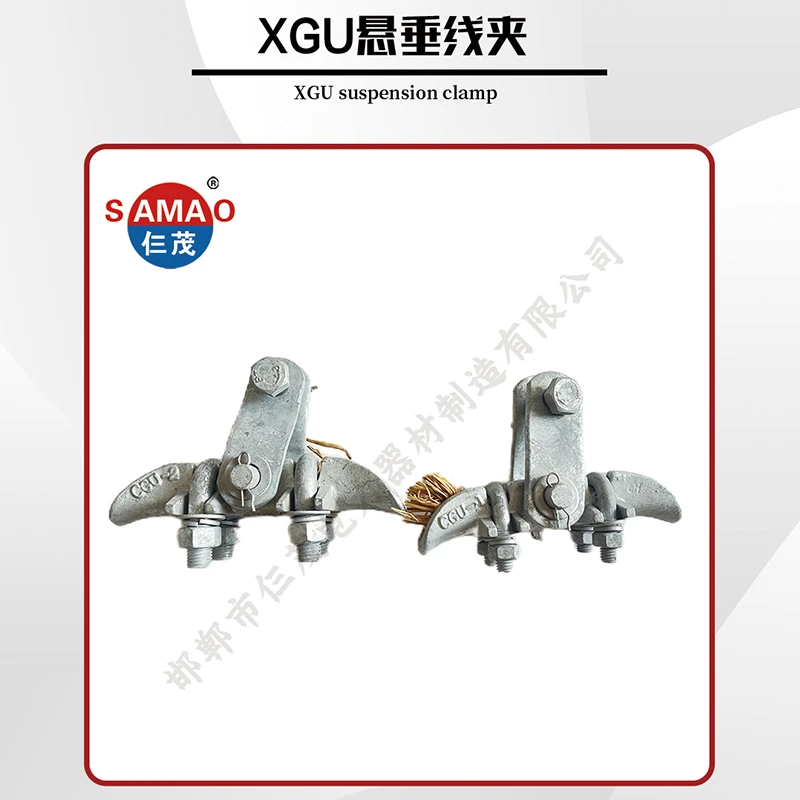
This is the most important limit for the hanger-type clamp. The hanger-type clamp is made of a hanger, U-bolts and a clamp body (keeper). As the body turns, the U-bolt eventually hits the hanger. That sets a maximum deflection angle, which the description treats as a safe operating limit.
The angle you need depends on:
- the overhang (line) angle of the conductor or ground wire on both sides of the suspension point;
- the diameter of the conductor or ground wire, including wrapping or armour rods.
If the angle at a tower is greater than the clamp's maximum deflection angle, the standard clamp does not apply. The description lists these options:
- use a double clamp arrangement;
- adjust the tower height;
- have a special clamp designed.
Send line-angle data for each tower with your enquiry so the right option can be confirmed.
5. Review grip and load behaviour
For the preformed set, the description says the grip force on the cable is "greater than 10%-20% of the rated tensile strength of the cable." More generally, it says the suspension clamp is designed to withstand the tension the wire produces in normal use, so the wire does not loosen or get damaged. These are product description statements, not test reports. If your specification needs a set slip-load value or documented test results, ask for them in writing before you place an order.
6. Confirm material against the site environment
The description says suspension clamps are generally made from high-strength, corrosion-resistant materials such as galvanized steel, aluminium alloy or stainless steel. It says these materials are meant to resist high humidity, salt spray and extreme weather. Because the source lists these as typical options, not as a fixed build for each model, confirm the actual material and surface treatment of the model you are quoted. This matters most for coastal, humid or industrial sites.
7. Plan the installation
The description says the clamp is simple to install and normally needs no complex tools or special expertise: the wire is placed in the clamp and held by tightening the bolt. The preformed design is also described as easy to install. Your line crew should still follow the project's own installation and safety procedures.
Quick selection checklist
| Check | What to confirm |
|---|---|
| Tower position | Straight-line (tangent) support point |
| Line type | Bare Al, Al alloy, copper conductor, ground wire, ADSS or OPGW |
| Clamp style | Hanger type (hanger, U-bolts, body) or preformed set |
| Diameter | Outer diameter including tape or armour rods |
| Deflection angle | Line angle at each tower within the clamp's maximum |
| Grip and load | Needed values and supporting documents |
| Material | Actual material and finish for the site environment |
When this recommendation does not apply
- Dead-end or tension positions.
- Towers where the line angle is greater than the clamp's maximum deflection angle. You will need a double clamp, a tower height change or a special design.
- Projects that need specific certifications, test reports, prices or delivery dates. None of these are in the confirmed materials, so request them directly.
If you are comparing suppliers for a wholesale suspension clamp order, send the checklist items above with your enquiry. Handan Samao Electric Power Equipment ManufacturingCo., LTD. can then confirm which version of its Suspension Clamp fits your line.
THE PEOPLE

About the author
THE COMPANY
Handan Samao Electric Power Equipment ManufacturingCo., LTD.
Handan Sanmao Electric Power Equipment Manufacturing Co., Ltd. was founded in 1996. It is an earlier and larger enterprise specializing in the production of power equipment and power fittings in Handan City. The company covers an area of approximately more than 23,000 square meters, and the factory building area is more than 12,000 square meters. The sales area and office building are more than 2,000 square meters.…
About Us ↗Visit company website ↗YOUR NEXT STEP
Bring your brief. Start a useful conversation.
Use case, specification, quantity and delivery window: make the next conversation specific.
-
Suspension Clamp Questions: Cable Fit, Grip and DeflectionNewsNov.02,2026
-
Dead End Strain Clamp FAQ: Specifications, Selection and Ordering QuestionsNewsOct.30,2026
-
Premium Power Hardware co de vendas de equipamentos elétricos e incNewsJul.01,2026
-
Optimize Power Distribution with Painel Elétrico PersonalizadoNewsJun.29,2026
-
Guide for compradores de equipamentos elétricos on GroundingNewsJun.27,2026
-
Professional empresa de equipamentos elétricos for Power InfrastructureNewsJun.26,2026
-
Tension Clamps Guide and Finding a Reliable distribuidor de cableNewsJun.25,2026