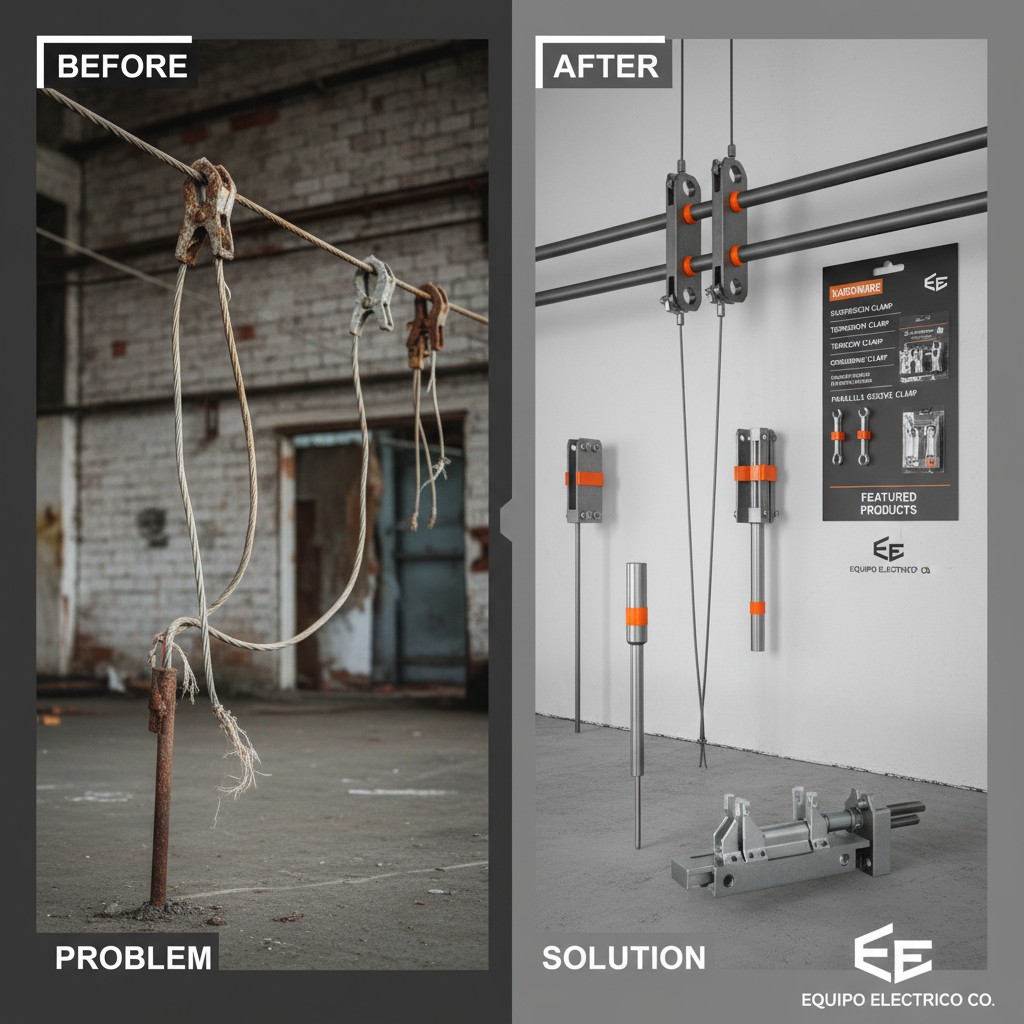
Securing overhead power and communication lines requires more than just basic fasteners; it demands a precise balance of tensile strength, vibration damping, and environmental resilience. The stability of a grid often depends on the smallest components, where a failure in a single clamp can lead to cascading outages or hazardous wire sags.
Modern infrastructure projects are increasingly utilizing advanced materials and specialized geometries to handle the stresses of ADSS and OPGW cables. As utility companies migrate toward higher-capacity lines and more complex tower layouts, the technical requirements for hardware have shifted from simple support to active load management and corrosion prevention.
Understanding the operational limits and selection criteria used by professional suspension clamp manufacturers is essential for engineers seeking to maximize the service life of high-altitude lines and reduce long-term maintenance costs.


The primary function of a suspension clamp is to provide a secure fixing point for conductors on power towers or poles. Unlike tension clamps that anchor the line, suspension clamps support the weight of the wire, preventing offset caused by thermal expansion, wind load, and gravity.
For specialized lines like ADSS (All-Dielectric Self-Supporting) or OPGW (Optical Ground Wire), the mechanics shift toward protection. Pre-stranded hang wire clips use a combination of inner and outer spiral layers to encapsulate the cable, ensuring there is no concentrated stress or bending fatigue on the delicate optical cores.
Engineering a reliable clamp begins with material selection. High-strength galvanized steel, aluminum alloys, and stainless steel are the industry standards, chosen for their ability to withstand extreme weather, salt spray in coastal regions, and high humidity. These materials prevent rust and corrosion, which are the primary drivers of structural failure in overhead lines.
The design logic focuses on grip force and stability. A high-quality clamp ensures that the grip force is significantly higher than the rated tensile strength of the cable—typically between 10% to 20%—to avoid slippage during peak wind events. This is achieved through precise CNC machining and a secure bolting system that minimizes the need for complex installation tools.
Furthermore, the integration of vibration-reduction features is critical. By absorbing shock from wind-induced oscillations or seismic activity, the clamp protects the wire from fatigue failure, ensuring the long-term stability of the power system even in high-risk geographic areas.
One of the most critical safety constraints in wire suspension is the maximum deflection angle. This is the limit to which a clamp can tilt before the hull is blocked by the hanger or U-shaped screws. If the angle of the wire relative to the tower exceeds this limit, the structural integrity of the suspension point is compromised.
The maximum deflection angle is not a fixed constant but a variable dependent on the wire diameter, the thickness of aluminum wrapping belts, and the specific overhang angle of the ground wire at the suspension point.
When these limits are exceeded, engineers must implement corrective measures. This may include upgrading to double wire clips, adjusting the tower height to change the angle of incidence, or commissioning a custom design from the manufacturer to accommodate the specific topography of the site.
Comparing different suspension solutions requires a quantitative approach. Factors such as load balancing, corrosion resistance, and installation efficiency are weighed against the specific needs of the project. For instance, in high-temperature environments, heat resistance becomes a primary metric, whereas in coastal zones, the thickness of the galvanization is the priority.
The following analysis uses a relative index to illustrate how different design priorities influence the overall value of a suspension clamp system.
In a typical industrial setting, such as the expansion of a regional power grid, the selection of clamps must match the wire type. For bare aluminum or copper wires, a standard suspension clamp is often sufficient. However, when deploying fiber optic communication lines, the use of pre-stranded clips is non-negotiable to protect the signal-carrying cores from bending stress.
Manufacturers like Handan Sanmao Electric Power Equipment Manufacturing Co., Ltd. integrate CNC production lines to ensure that these components meet the rigorous standards of entities like the State Grid. By focusing on load balancing, these products ensure that weight is evenly distributed across the support structure, extending the lifespan of both the wire and the tower.
The trend in power hardware is moving toward "intelligent" and "low-carbon" manufacturing. This involves reducing material waste during the casting process and utilizing environmentally friendly surface treatments that provide superior corrosion resistance without toxic runoff.
There is also a growing demand for highly adaptable clamps that can serve multiple wire diameters. This versatility reduces the inventory burden for utility companies and simplifies the logistics of large-scale infrastructure rollouts across diverse terrains.
As we look forward, the integration of composite materials may further reduce the weight of suspension hardware while increasing its strength-to-weight ratio, allowing for lighter tower designs without sacrificing safety.
Choosing the right hardware requires a trade-off analysis between initial cost, installation speed, and long-term durability. A lower-cost clamp might save budget in the short term but could lead to frequent replacements if it lacks sufficient corrosion resistance for the local environment.
The evaluation process should prioritize the "safe operating condition," specifically the relationship between the wire's outer diameter (including protective wrapping) and the clamp's hull geometry.
The following framework provides a relative suitability guide based on common infrastructure requirements.
| Requirement | Standard Clamp | Pre-stranded Clip | Custom Alloy Clamp |
|---|---|---|---|
| Bare Aluminum Wire | High Suitability | Low Suitability | Moderate Suitability |
| ADSS/OPGW Cable | Low Suitability | High Suitability | Moderate Suitability |
| Coastal Environment | Moderate Suitability | Moderate Suitability | High Suitability |
| High-Vibration Zone | Low Suitability | High Suitability | High Suitability |
| Fast Installation | High Suitability | Moderate Suitability | Moderate Suitability |
| Extreme Heat | Moderate Suitability | Moderate Suitability | High Suitability |
A suspension clamp is designed to support the weight of the conductor and hold it in position on a tower, allowing the wire to hang. In contrast, a tension clamp is used at dead-end structures or angle poles to anchor the wire and resist the longitudinal pull of the span. Suspension clamps focus on load distribution and vibration damping, while tension clamps focus on extreme tensile strength and secure anchoring.
Pre-stranded clips use a specialized spiral winding of inner and outer layers. This structure distributes the gripping force evenly across the cable's surface, preventing concentrated stress points that could crush the fiber optic core. By avoiding bending stress and providing auxiliary vibration reduction, these clips ensure signal integrity and prevent physical degradation of the cable over time.
The maximum deflection angle is influenced by the geometry of the clamp's hull and the physical dimensions of the wire. Key factors include the outer diameter of the wire (including aluminum wrapping), the overhang angle of the ground wire on both sides of the suspension point, and the position of the U-shaped screws. If the angle exceeds the design limit, the screw may be blocked, compromising the safety of the connection.
Stainless steel and high-grade galvanized steel are most effective in these environments. Hot-dip galvanization creates a protective zinc layer that prevents the base steel from oxidizing when exposed to salt spray and moisture. For extreme conditions, aluminum alloys are also used due to their natural oxide layer, which provides excellent weather resistance and prevents rust.
Signs of excessive stress include visible deformation of the clamp hull, slipping of the wire within the grip, or fraying of the conductor strands at the point of contact. Additionally, if the clamp has reached its maximum deflection angle and is leaning against the hanger, it is a critical indicator that the tower height or clamp type needs to be adjusted to ensure safety.
While some basic clamps may physically fit both, it is not recommended. Power lines require high tensile strength and conductivity considerations, whereas communication cables (like ADSS) require delicate stress management to avoid signal loss. Using a power-grade clamp on an optical cable can cause concentrated stress and lead to fiber breakage, making specialized clips essential for communication infrastructure.
The integrity of any electrical grid is only as strong as its weakest connection. By prioritizing technical specifications such as deflection limits, material corrosion resistance, and specific cable compatibility, operators can significantly mitigate the risk of unplanned outages and infrastructure failure.
Investing in precision-engineered hardware from experienced manufacturers ensures that these critical support points remain stable through decades of environmental exposure, providing a reliable foundation for the global transition toward smarter, more resilient power and communication networks.