Guide to Suspension Clamps and mid clamp and end clamp price
Ensuring the structural integrity of overhead power and communication lines requires a sophisticated approach to wire suspension and tension management. For engineers managing ADSS or OPGW cables, the choice of suspension hardware is not merely a procurement detail but a critical safety decision. The interaction between the cable and the support structure must account for environmental stressors, vibration, and tensile forces to prevent catastrophic failure. This guide examines the technical nuances of pre-stranded hang wire clips and suspension clamps, focusing on how their design mitigates concentrated stress and prevents bending fatigue in high-voltage environments.

Technical Engineering of Pre-Stranded Hang Wire Clips for Optical Cables
The Pre-stranded hang wire clip is specifically engineered for the complex requirements of ADSS and OPGW cables. Unlike standard clamps, these devices utilize a combination of inner and outer layers of spiral pre-stranded wire. This multi-layered architecture is essential for protecting the sensitive internal fibers of an optical cable by distributing the grip force evenly across the cable surface. By eliminating concentrated stress points, the clip prevents the bending stress that typically leads to signal attenuation or physical breakage of the cable core.
From a mechanical perspective, the entire assembly comprises the suspension head, matching connecting metal, and the pre-stranded wires. A critical performance metric is the grip force, which is designed to exceed 10%-20% of the cable's rated tensile strength. This ensures that the cable remains securely fixed even under extreme wind loads or icing conditions. However, installation must strictly adhere to the maximum deflection angle limits. If the angle between the wire and the support exceeds the safety threshold, the U-shaped screw may be blocked by the hanger, necessitating a transition to double wire clips or adjusted tower heights to maintain operational safety.

Core Functional Characteristics of Professional Suspension Clamps
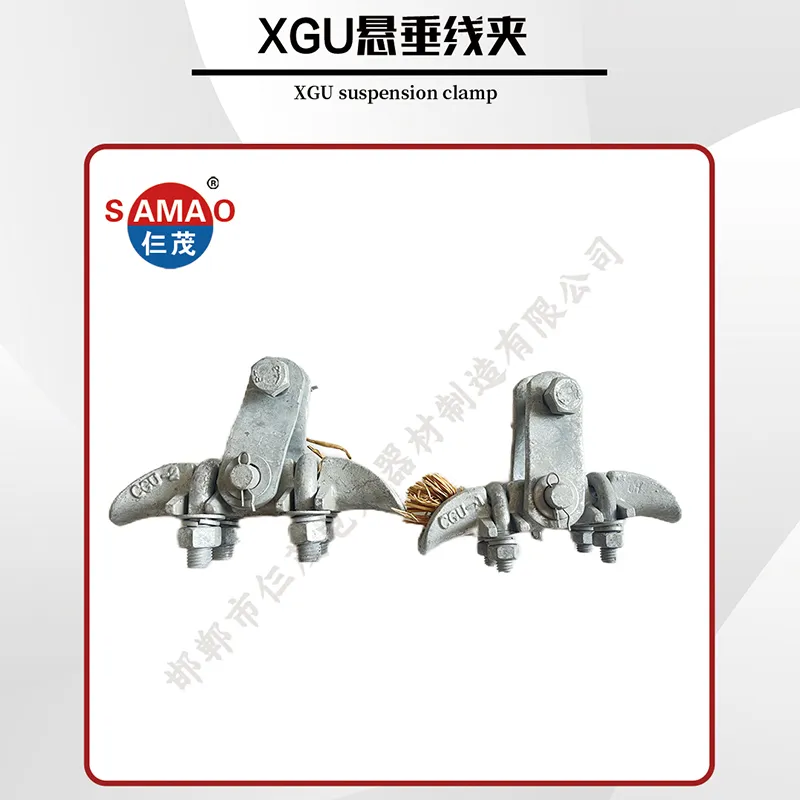
Suspension clamps serve as the primary load-bearing interface between the conductor and the power tower. To ensure long-term stability, these components must exhibit high tensile strength and exceptional corrosion resistance. Most industrial-grade clamps are manufactured from galvanized steel, aluminum alloys, or stainless steel, allowing them to withstand high humidity and salt spray in coastal or industrial zones. This material selection is vital for extending the service life of the grid infrastructure and reducing maintenance frequency.
Beyond simple support, advanced suspension clamps are designed to balance the load and reduce mechanical vibration. In high-risk areas prone to seismic activity or strong winds, the clamp acts as a dampening mechanism, absorbing shocks that would otherwise damage the wire. Their adaptability is another key advantage; they are compatible with various wire types, including bare aluminum, aluminum alloy, and copper wires. The installation process is streamlined for efficiency, typically requiring only the placement of the wire into the clamp and the tightening of a securing bolt, which significantly lowers labor costs during large-scale deployments.
Operational Application Scenarios and Deployment Considerations
The deployment of suspension hardware varies significantly based on the environment and the type of line being installed. In overhead power lines, the focus is on load distribution and heat resistance. Some specialized clamps are designed for high-temperature environments, ensuring that the grip remains secure even as the conductor expands due to thermal loads. In contrast, communication and optical fiber lines prioritize the prevention of micro-bending and stress concentration to maintain data transmission quality.
When selecting hardware, engineers must evaluate the specific tower type and support structure. The versatility of modern clamps allows them to be applied to everything from standard utility poles to massive transmission towers. A common challenge in the field is managing the "drape" of the wire; if the angle is too steep, the mechanical advantage of the clamp is reduced. In such cases, adjusting the tower height or employing custom-designed clips is necessary to ensure the wire does not slip or suffer from excessive local friction.
Technical Evaluation and Selection Framework
| Selection Factor | Standard Suspension Clamp | Pre-Stranded Hang Clip | Impact on Reliability |
|---|---|---|---|
| Cable Compatibility | Bare Aluminum/Copper | ADSS/OPGW Optical | High - Prevents fiber damage |
| Stress Distribution | Direct Contact | Spiral Layering | Critical - Reduces stress concentration |
| Environmental Resistance | Galvanized/Alloy | High-Grade Galvanized | Medium - Extends service life |
| Installation Complexity | Low (Bolt-on) | Moderate (Layering) | Low - Affects deployment speed |
| Vibration Damping | Basic Support | Integrated Reduction | High - Prevents fatigue failure |
Quality Assurance in Power Fitting Manufacturing
The reliability of a suspension clamp is only as good as the manufacturing process behind it. High-performance fittings require a rigorous total quality management system, integrating CNC production lines for precision and automated online testing for consistency. The chemical and physical testing of the base metals—ensuring the correct alloy composition and galvanization thickness—is what prevents premature rust and structural failure in the field. A full-process computer control system allows for the tight tolerances necessary to ensure that every bolt and hull fits perfectly, reducing the risk of loosening over time.
For procurement managers, evaluating a supplier's certification, such as ISO9001, ISO14001, and ISO18001, is a baseline requirement. However, true quality is seen in the ability to meet the stringent standards of entities like the State Grid or China Southern Power Grid. These organizations require products that not only meet nominal specifications but also perform under simulated extreme weather conditions. Choosing a manufacturer with a proven track record in national-scale infrastructure projects ensures that the hardware can handle the actual tensions of a live grid.
Procurement Strategy and Cost-Value Analysis
When analyzing the mid clamp and end clamp price, buyers often make the mistake of focusing solely on the unit cost. In the power industry, the "total cost of ownership" is the only relevant metric. A cheaper clamp that fails in five years results in exponential costs due to emergency repairs, power outages, and labor for replacement. Investing in high-strength, corrosion-resistant materials and precision-engineered designs reduces the lifecycle cost by extending the interval between maintenance cycles.
A strategic procurement approach involves specifying the exact environmental conditions—such as salt spray levels, maximum expected wind speeds, and temperature fluctuations—to get a tailored recommendation. Whether opting for standard hardware or custom-designed solutions, the goal is to match the clamp's tensile strength and grip force to the cable's specifications. By partnering with manufacturers who offer full-process quality control and technical support, utilities can ensure their infrastructure remains resilient against the unpredictability of nature.
Technical FAQ for Power Line Suspension Hardware
What is the primary difference between a standard suspension clamp and a pre-stranded hang wire clip?
Standard suspension clamps provide basic support and fixing for conductors like aluminum or copper. Pre-stranded hang wire clips are specifically designed for optical cables (ADSS/OPGW), using spiral layers to protect the cable from concentrated stress and bending, which is critical for maintaining data signal integrity.
How do I determine the maximum deflection angle for a hang wire clip?
The maximum deflection angle depends on the diameter of the wire (including protective layers) and the angle of the ground wire on both sides of the tower. If the hull turns beyond a certain limit, the U-shaped screw is blocked by the hanger, indicating the safety limit has been reached.
Which materials are best for suspension clamps in coastal areas?
In high-salinity coastal environments, stainless steel or high-grade hot-dip galvanized steel are recommended. These materials provide the necessary corrosion resistance to prevent rust and maintain structural integrity against salt spray and high humidity.
What happens if the grip force of the clamp is too low?
If the grip force is insufficient (below 10%-20% of the rated tensile strength), the cable may slip during high-wind events or temperature drops, leading to sagging or complete line failure, which poses a significant safety risk.
Can these clamps be used for all types of optical cables?
While they are designed for ADSS and OPGW cables, the specific model must match the cable diameter. Using a clamp that is too large or too small will either fail to secure the cable or cause excessive compression, damaging the optical fibers.
How can I reduce the impact of wind-induced vibration on the wires?
Using suspension clamps with vibration-reduction characteristics helps dissipate energy. Additionally, ensuring the clamp is properly seated and the tension is balanced across the support structure reduces the likelihood of aeolian vibration damage.
Industry Technical References
- IEEE Xplore - Power Engineering Standards
- International Electrotechnical Commission (IEC)
- ASME - Materials and Mechanical Engineering
- ISO Quality Management Systems for Manufacturing
Selecting the right suspension hardware is a balance of technical precision and long-term value. By prioritizing materials and designs that address the specific stresses of your environment, you ensure the reliability of your power and communication infrastructure for decades to come.
Related Infrastructure Solutions